A SOCIAL HOUSING FUTURE FUND:
SUSTAINABLE FUNDING FOR SOCIAL HOUSING
OR A MIRAGE
|
For this initial Christmas edition, The Jakob Fugger Bulletin takes a
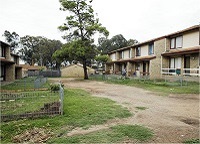
look at funding for the Australian social housing system - the
inadequacy of which can be inferred from a glance at the pictures
above. This is a fitting initial topic given the season and that the
Bulletin’s namesake, Jakob Fugger (pictured above in a painting by
Albrecht Dürer) established a social housing estate in Augsburg back in
1521 - an estate that is still in use today.
The Bulletin presents an Occasional Paper
prepared by
Shepherd Shaw reviewing
a recent report by Infrastructure
Partnerships
Australia (“IPA”). The IPA report, entitled “From
Housing Assets to
Housing People: Fixing
Australia’s Housing System”, makes strong claims for the proposed
Social
Housing Future Fund (“IPA Fund”). The Occasional Paper, while
applauding the IPA contribution, expresses reservations as to the
ability of the IPA Fund to deliver the
claimed outcomes.
Download the Occasional Paper.
In addition to reviewing the IPA report, the Occasional Paper outlines
an alternative approach that
can be expected to optimise value-for-money and concludes: with an
outline of the broad cost to taxpayers of the social housing system for
a range of future trajectories; with a summary of likely funding
sources; and with an appeal for action in place of magical/wishful
thinking and procrastination.
The IPA report, notwithstanding the reservations expressed in the
Occasional Paper, is a professional, useful and timely contribution to
the discussion of how best to provide adequate social housing
infrastructure, an issue with which all jurisdictions
struggle. The IPA report neatly restates the very
unsatisfactory current situation in Australia as documented elsewhere
by the Australian Productivity Commission, the Auditor-General of New
South Wales (“NSW”) and others.
For this reason alone, the IPA report, in conjunction with the
Occasional Paper, should be closely read by policy makers and by any
community housing provider (“CHP”) or consortium currently working to
execute a contract in relation to the NSW government’s Social &
Affordable Housing Fund (“SAHF”), or contemplating a bid in relation to
the NSW government’s social housing stock transfer initiative.
The IPA report, in conjunction with the Occasional Paper, brings a
clear focus on the cost of delivering social housing, including the
existing level of maintenance backlog in the portfolio and the
whole-of-life costs of maintenance and ownership - particularly
relevant for anyone contemplating a 20-year contractual commitment.
The IPA scheme involves the sale of the bulk of the Australian social
housing portfolio to private owners, with replacement and additional
social housing then leased from the private market. Such a
sale can be expected to be beneficial to the extent that:
- It
mobilises/drives private sector efficiencies (in cost and in outcomes)
- The
ongoing operation of the - then more efficient - social housing system
is responsibly funded
- The
sales proceeds are invested in government projects/initiatives with
high economic benefit/cost ratios.
However,
the IPA report also proposes the establishment of the IPA Fund for the
purpose of investing the proceeds of sale into shares, bonds, and other
securities - a Commonwealth Future Fund (“CFF”) for social
housing. The investment returns from the IPA Fund would be
used to lease the required replacement and additional social housing
from the private market through CHPs and other providers. The IPA
report indicates that the IPA Fund has been modelled using NSW as an
example jurisdiction.
Based on this modelling, the IPA report makes strong claims for the IPA
Fund, including:
- That
the NSW stock could be increased from 126,000 properties to 157,000
properties over 20 years, thereby stabilising the waiting list
- That
the level of support services for social housing tenants could be
expanded
- That
the cost to government of the social housing system could be reduced to
zero
- That
additional government revenue could be generated through stamp duties
and savings in Commonwealth Rent Assistance (“CRA”)
- That
these gains could be achieved in a financially sustainable manner and
without excessive risk.
The
implication in the IPA report is that further stock growth could be
sustainably achieved in later years (i.e. beyond 20 years) and that
similar outcomes could be expected in other jurisdictions.
Intuitively, this sounds too good to be true. The most
obvious high-level objection is that, if this approach is possible,
then surely every jurisdiction in the world would have implemented it
already. And yet they do not seem to have done so. Further, if this
approach is possible for social housing, then surely
it will work for every other infrastructure sector - roads, schools,
ports, police stations, hospitals, water, etc. Indeed, why do
governments not borrow money (at their low cost of borrowing), invest
it in securities and use the resulting gains to fund everything we
desire? The answer may lie, partly or in full, in the fact
that governments generally have other investment options available that
will generate higher economic returns than can be earnt by an
investment in securities.
Notwithstanding the scepticism generated by this high-level objection,
the IPA report deserves more detailed consideration. The IPA
has not publicly released its model or fully disclosed its key
modelling assumptions. While this makes it difficult to be
definitive, Shepherd Shaw has undertaken its own modelling using
defensible assumptions and has been unable to validate the claims for
the IPA Fund.
On the contrary, Shepherd Shaw’s modelling indicates that, in NSW, the
existing $38 billion endowment (i.e. the market value of the existing
NSW social housing stock) could be expected to be exhausted over the
long term if the IPA Fund were implemented. This conclusion
rests on two key factors:
- For
the IPA scheme, the main revenue source for government is the rent paid
by social housing tenants, which grows at about the same rate as the
CPI. The main cost to government is the market rent that is
paid to private owners, which grows at about the same rate as property
prices. The CPI, if history is any guide, can be expected to
be lower than the rate of property price growth, which means that
government net revenue will be squeezed over time forcing the sell down
and eventual depletion of the social housing endowment
- To
overcome this net revenue squeeze, the IPA Fund must generate a total
return that is higher than residential rental housing (about 3.5%
higher per Shepherd Shaw’s modelling). However, this
additional return will be accompanied by additional
volatility. Further, returns on residential rental housing
and returns on other securities are not well correlated.
Thus, Shepherd Shaw’s modelling suggests a high probability that the
IPA Fund would be depleted over the long term due to the sale of
securities to cover rents in periods of poor returns on other
securities.
This
raises the possibility that the IPA Fund may be a mirage, distracting
attention from the core underfunding issue, delaying substantive action
and potentially leaving the system in a worse position in the long term.
An alternative concession agreement approach is outlined that preserves
the sale of the social housing stock as suggested in the IPA report,
but which eliminates the IPA Fund. Instead, the sales proceeds would be
immediately deployed into government projects/initiatives having high
benefit/cost ratios, with ongoing concession payments funded
conventionally and the taxpayer reaping the private sector
efficiencies. This is the financial, economic and government
affordability equivalent of
recycling any other government infrastructure asset, such as a port or
an electricity transmission network.
The Occasional Paper concludes with an outline of the broad cost to
taxpayers of the social housing system for a range of future
trajectories, with a summary of likely funding sources and an appeal
for rational discussion and decision making - such as is exemplified by
the IPA report and, hopefully, the Occasional Paper - and for action
in place of magical/wishful thinking and procrastination.
Mark Shepherd
Principal
Mobile: + 61 421 618 238
Email: mshepherd@shepherdshaw.com.au
Web: www.shepherdshaw.com.au
|
|
|
“magical
thinking” ... the belief that one's thoughts by themselves can bring
about effects in the
world or that thinking something corresponds with doing it.
Colman,
Andrew M.(2012), A Dictionary of Psychology (3rd ed.), Oxford
University Press
|
THE JAKOB FUGGER BULLETIN presents commentary on issues
relevant to
infrastructure and real estate investment, financing and funding.
The
bulletin is named for Jakob Fugger (1459 - 1525), aka “Jakob the Rich”.
Jakob Fugger was a major merchant, mining entrepreneur and banker of
Europe. Through his financial support of the Habsburg dynasty,
he had a
decisive influence on European politics at the time. He financed the
rise of Maximilian I and made considerable contributions to secure the
election of the Spanish king Charles V to become Holy Roman Emperor.
Jakob Fugger also funded the marriages which later resulted in House
Habsburg gaining the kingdoms of Bohemia and Hungary.
In addition to his financial, economic and political influence, Jakob
Fugger apparently also had a social bent. The Fuggerei, which was
founded by Jakob
in 1521, is the world's oldest social housing complex still in use.
The Jakob Fugger Bulletin brings a rational and analytical
focus to the infrastructure and real estate sectors with an eye, like
Jakob
Fugger himself, on the ultimately social objectives and outcomes of
investment and on the tensions of the relationships between capital and
state and between individual and collective good.
[With thanks to Wikipedia for background on Jakob Fugger]
|
|
SHEPHERD
SHAW specialises in project finance, investment and
development across the infrastructure and real estate sectors.
Services include strategic advice, investment origination,
consortium
and process management, asset/investment management,
development/project management, and arranging debt and equity funding.
Contact Mark Shepherd for additional information.
Mark Shepherd
Principal
Mobile: + 61 421 618 238
mshepherd@shepherdshaw.com.au
www.shepherdshaw.com.au
|
|